[article] On the Cenoscopic and the Idioscopic

We are accustomed to viewing polarities in the world of knowledge lined up like adversaries: science versus religion; the sciences versus the humanities; the old science versus the new science, and so on. Recent attempts to arbitrate in the matter have been few and confused. But there was one exception. C. S. Peirce borrowed a pair of concepts from Jeremy Bentham, steeped them in the stew of his own particular genius, and passed them on to posterity. Mostly ignored, they were finally picked up by John Deely a century later. They play a crucial role in negotiating a newly identified homeland for philosophy, allowing it to survive its near shipwreck in recent times. A sustained meditation on their full implications, however, takes us even further. Still honoring the conquests of modern science, a restored epistemic homeland is offered not only to traditional philosophy, but also to the otherwise marginalized realms of the humanities and religion.… Read More [article] On the Cenoscopic and the Idioscopic

[article] How To Be a Contemporary Thomist: The Case of Marshall McLuhan

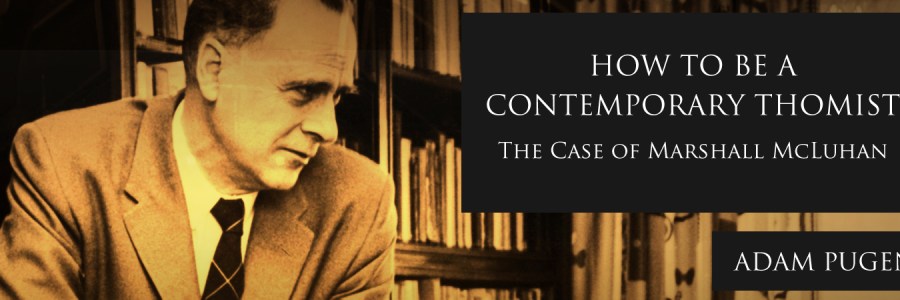
The provocative nature of both the form and content, “medium” and “message,” of Marshall McLuhan’s scholarship on technological culture has attracted a wide array of McLuhan interpreters of diverse intentions. It is well known, however, that McLuhan considered himself a follower of the thirteenth century scholastic Thomas Aquinas; as he wrote…… Read More [article] How To Be a Contemporary Thomist: The Case of Marshall McLuhan

[article] Was Reginald Garrigou-Lagrange a Personalist?

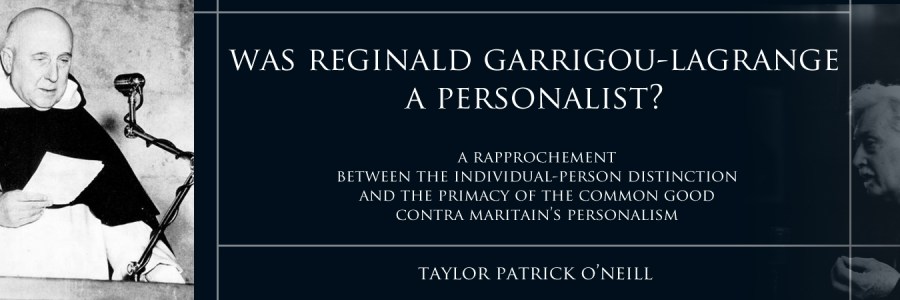
A Rapprochement Between the Individual-Person Distinction and the Primacy of the Common Good Contra Maritain’s Personalism[1] Taylor Patrick O’NeillAssistant Professor of TheologyMount Mercy UniversityCedar Rapids, IA ABSTRACT: This paper uses Garrigou-Lagrange in order to explore the wider question of a Thomistic response to personalism and the thought of Jacques Maritain. How ought Thomistic thinkers to… Read More [article] Was Reginald Garrigou-Lagrange a Personalist?

[Issue] The Philosophy of Realism

From the Editorial Introduction: This first issue of Reality—The Philosophy of Realism—like most publications and especially those of a collaborative effort, signifies innumerable hours of effort.  The goal of our journal is simple: to reinvigorate an intelligent discussion about realism as a philosophical approach.  By a realist approach, we mean not simply as pertains to… Read More [Issue] The Philosophy of Realism

Editorial Introduction – Reality as Katharsis

  Daniel C. Wagner, PhD Professor and Chair of Philosophy Aquinas College, Grand Rapids MI Editor, Reality  Brian Kemple, PhD Continuum Philosophical Insight Executive Editor, Reality This first issue of Reality—The Philosophy of Realism—like most publications and especially those of a collaborative effort, signifies innumerable hours of effort.  The goal of our journal is simple:… Read More Editorial Introduction – Reality as Katharsis

[Article] The Philosophical Implications of Sense Realism

A Response to Daniel Wagner James D. Capehart, Ph.D. Sacred Heart Apostolic School Rolling Prairie, IN [response to daniel wagner, “the logical terms of sense realism”] Download Issue Version PDF In his essay “The Logical Terms of Sense Realism: A Thomistic-Aristotelian and Phenomenological Defense” Daniel Wagner addresses the problem of universals and specifically the problem… Read More [Article] The Philosophical Implications of Sense Realism

[Article] Aquinas On Suppositum, Essence & Universals

  Seth Kreeger PhD Candidate Dominican School of Philosophy and Theology [online only response to daniel wagner, “the logical terms of sense realism”] Download as PDF Having read “The Logical Terms of Sense Realism: A Thomistic-Aristotelian & Phenomenological Defense” I find myself to be quite in agreement with Professor Wagner about the impossibility of nominalism… Read More [Article] Aquinas On Suppositum, Essence & Universals